We've told this story before, but it bears repeating. One Saturday afternoon we walked into an upscale Woodinville tasting room. Beautiful space. The wines were excellent. Tasting fee was $25 per person—steep but not outrageous for what we were getting.
Then came the bottles. All started at $60. We liked the wine, but not at that price. Still, with $50 of tasting fee credit burning a hole in our pockets, we bought two bottles we probably wouldn't have purchased otherwise.
Had we known the pricing up front, we would have picked a different spot. One that better matched our budget. One where the tasting fee and wine prices made sense together. Instead, we spent an afternoon feeling quietly pressured into a purchase that didn't feel right.
That experience helped us understand why PourPlan needed to exist. Because tasting fees aren't just about the number on the menu. They're about whether you're getting value for that money, whether the waiver policy creates pressure you didn't ask for, and whether the winery is being transparent about what you're walking into.
Let's talk about what makes a tasting fee fair, what you're actually paying for, and how to spot when you're being taken for a ride.
What You're Actually Paying For
Here's what people get wrong: they think the tasting fee goes to the person pouring the wine. It doesn't. That's a separate issue we covered in our tipping guide.
The tasting fee covers the cost of running the tasting room itself. Real costs. Not theoretical ones.
The wine. Two ounces per pour doesn't sound like much until you multiply it by six wines and a hundred visitors per week. That's real inventory walking out the door in glasses instead of bottles.
Glassware. Quality stemware costs money. Breaking it costs more. Washing and maintaining it—every single day—adds up fast.
Staff wages. In Washington, minimum wage is $16.66 statewide and $21.30 in Seattle. Someone spending 45 minutes with you, explaining terroir and answering questions about oak aging, is doing skilled hospitality work. The tasting fee helps cover that labor.
Location overhead. This is where things get interesting. A warehouse tasting room in Woodinville has fundamentally different economics than a chateau on Napa Valley's hillside. Napa wineries face some of the highest real estate, insurance, and operating costs in the world. One winery saw its annual insurance premium jump from $200,000 to $800,000 after the California wildfires. Those costs show up in the tasting fee.
The experience. Post-pandemic, many wineries shifted to reservation-only formats with enhanced hospitality—food service, private tables, extended time with hosts. That shift drove prices up significantly, but it also fundamentally changed what you're paying for.
The fee isn't arbitrary. But that doesn't mean every fee is justified.
The Tasting Fee Explosion
In 2012, the average Napa tasting fee was $22. The national average was $8.50.
Today? Napa averages $75 for a standard tasting and $138 for reserve experiences. A basic tasting in Napa reached $40.62 in 2022, up from $20 in 2016. Elevated tastings? Now averaging $82.26, up from $30 just six years earlier.
Paso Robles has seen fees jump to $50-$100 at many wineries. Even mid-tier wine regions now routinely charge $25-$40 for what used to be a $10 experience.
The result? Napa's visitor numbers are down 37% since 2016. Sonoma's down 32%. People are voting with their feet.
And wineries are noticing. Nearly a third of Napa Valley wineries have recently lowered tasting fees or are considering it to attract visitors who've been priced out of wine country.
The question isn't whether fees have risen—they have, dramatically. The question is whether what you're getting justifies the price.
What Makes a Tasting Fee Worth It
Not all $50 tastings are created equal. Some deliver extraordinary value. Others feel like robbery. Here's how to tell the difference.
Pour size matters. Standard is 2 ounces. Some wineries pour as little as 1.5 ounces, hoping you won't notice. You will. Over five or six wines, that difference compounds—you're getting 25% less wine for the same price. If a winery is skimping on pours, question what else they're cutting corners on.
Number of wines matters. Four wines for $40 is a different proposition than six wines for $40. Do the math. Know what you're getting.
Wine quality matters. Are you tasting $25 bottles or $75 bottles? Are these wines winning 90+ point scores from critics, or are they middling production wines you could find at Costco? Professional ratings and visitor sentiment tell you whether the wine quality justifies premium fees.
Service quality matters. Even the best wines can be overshadowed by poor service, while attentive hosts can elevate a modest tasting. Is your host knowledgeable? Passionate? Actually spending time with you, or rushing through to flip tables? Premium fees should come with premium hospitality.
Experience matters. Are you standing at a crowded bar or seated at a private table overlooking vineyards? Premium tastings should include reserve wines, food pairings, extended time with knowledgeable hosts, or private settings. If you're paying $75 and getting the same rushed bar experience as a $20 tasting down the road, something's wrong.
Waiver terms matter. This is where things get psychologically complicated. And we need to talk about it.
The Waiver Game: How "Refundable" Fees Create Pressure
"Tasting fee waived with purchase" sounds generous. Sometimes it is. Sometimes it's a trap.
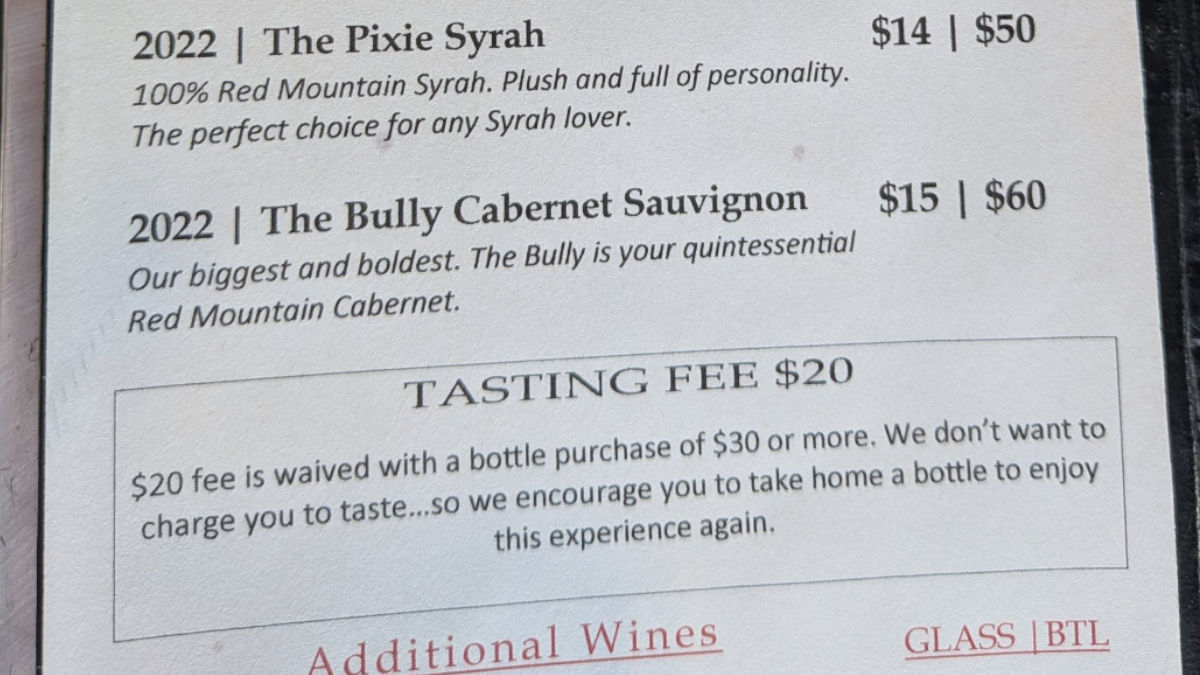
Waiver policies vary wildly. Some wineries waive the fee when you buy one bottle. Others require six bottles. Some credit the fee toward your purchase rather than waiving it—subtle difference, same effect.
Here's what happens psychologically. You walk in knowing the $25 tasting fee is refundable with purchase. You taste the wines. They're fine—not amazing, but fine. You weren't planning to buy, but now you have $25 (or $50 for two people) on the line.
Suddenly you're not asking "Do I love this wine enough to buy it?" You're asking "Would I rather buy a bottle I'm lukewarm about, or eat a $50 sunk cost?"
We've been there. We bought two bottles of wine we weren't enthusiastic about because the refundable fee created pressure to purchase. When we opened them at home, our initial instincts were right. We turned a short disappointment into multiple nights of disappointment, and paid for the privilege.
The waiver policy isn't inherently bad. But it changes the transaction from "try before you buy" to "buy or lose your deposit." Some wineries use this intentionally. They know the sunk cost fallacy works. They're counting on it.
Some wineries are more transparent—they charge a tasting fee and keep bottle prices reasonable, so a purchase feels like a genuine choice rather than fee recovery. Others price bottles high enough that the waived fee feels like the only financially rational move, even when the wine doesn't justify it.
Know which game you're playing before you sit down.
Location Economics: Why Overhead Matters
Napa and Woodinville don't operate under the same rules.
Napa Valley has some of the most expensive land, labor, and insurance costs in California. A tasting room on a hillside estate with manicured gardens and a full hospitality staff has fundamentally different overhead than a warehouse tasting room in Woodinville where the winemaker pours on weekends.
Sonoma averages $43 for a standard tasting, compared to Napa's $75. Oregon averages $32. Emerging regions? Often $15-$25.
Higher overhead doesn't automatically justify higher fees—but it explains them. What matters is whether the winery is passing along legitimate costs or opportunistically charging what the market will bear because they can.
The difference shows in the details. A $75 Napa tasting that includes estate vineyard views, library wines, and a knowledgeable host who spends an hour with you? That can be worth it. A $50 fee in a generic tasting room with rushed service and commodity wines? That's gouging.
Compare regionally. If everyone in Woodinville charges $15-$25 and one winery charges $50, they better have something extraordinary to justify it. If they don't, you're being taken.
The Hidden Fee Problem: Know Before You Go
Here's the thing that drives us crazy: some wineries purposely make their fees hard to find.
No pricing on the website. No mention of waiver policies. You show up, sit down, taste the wines, and then find out it's $40 per person with a two-bottle minimum purchase for the waiver.
This isn't an accident. It's a strategy. Get people in the door, get them tasting, get them emotionally invested, then reveal the terms. By that point, walking out feels awkward. So people stay, and they pay.
We've seen it. Wineries that bury their fee structure, avoid answering questions about pricing, or give vague answers when you call. That's a red flag the size of a vineyard.
Contrast that with wineries that publish their fees prominently, explain their waiver policies clearly, and give you the information you need to decide whether it's worth your time. That transparency signals confidence in their value proposition.
If a winery won't tell you the fee before you arrive, assume it's because they know you wouldn't come if you knew.
How PourPlan Rates Tasting Fees
We built PourPlan because we got tired of walking into situations blind. Tired of discovering pricing after we'd already committed. Tired of feeling gouged by wineries that hid their fees and leveraged sunk cost psychology.
So we made tasting fee transparency a core part of our rating system.
Tasting Fee is one of our 7 rating dimensions, weighted at 20%—tied for the highest weight in our composite score. That's not arbitrary. It reflects how much this issue matters when you're planning a wine tasting day.
Here's what we evaluate:
-
How does the fee compare regionally? A $25 fee in Woodinville is steep. A $25 fee in Napa is a bargain. Context matters.
-
Is it refundable or waivable? What are the terms? One-bottle minimum to waive is generous. Six-bottle requirement is aggressive. We document the actual policy so you know what you're getting into.
-
How many pours do you get? What's the pour size? Four 1.5-ounce pours for $40 is very different from six 2-ounce pours for $40. We factor that in.
-
What's the wine quality? If you're paying $50 to taste $100+ bottles with 95-point critic scores, that's defensible. If you're paying $50 to taste $30 bottles with no professional recognition, that's a problem.
Examples from our rated wineries:
- Laterus Winery earned a 7.5 Tasting Fee score—refundable with purchase, reasonable pricing for the quality, transparent policies.
- Love That Red Winery also scored 7.5—$20 fee for 4 pours, refundable with purchase, solid value for warehouse district pricing.
We've rated 112 wineries and growing. Every one includes tasting fee information, waiver policies, and our assessment of whether you're getting fair value.
As far as we know, PourPlan is the only platform that systematically evaluates tasting fees and waiver policies to help you avoid getting screwed.
Google reviews don't break down fee fairness. Yelp doesn't tell you waiver terms. Winery websites often hide the details. We put it all in one place so you can make informed decisions before you drive 40 minutes to a disappointment.
Making Tasting Fees Work for You
You can't change what wineries charge. But you can be strategic about where you spend your time and money.
Research fees before you go. Check the winery website, call if necessary, or use PourPlan to see documented fees and policies. Don't walk in blind.
Ask about waiver terms upfront. "What's your tasting fee, and what are the terms for waiving it?" It's a reasonable question. If they dodge it, that's information.
Do the value math. How many wines? What quality? What's the experience? Does the fee make sense for what you're getting? If the answer isn't clearly yes, keep looking.
Know your budget before you arrive. If you're planning to buy wine, great—factor that into the fee decision. If you're just tasting, accept the fee as the cost of the experience and don't let waiver pressure change your plan.
Compare regionally. If you're in Woodinville and one winery charges double the local average, they better have something exceptional to justify it. If they don't, vote with your feet.
Use PourPlan's ratings. We've done the research. We've documented the fees. We've scored the value. Filter wineries by what matters to you and see how their tasting fees stack up.
The PourPlan Take
Tasting fees aren't inherently bad. They cover real costs—wages, glassware, location overhead, the wine itself. When a winery charges a fair fee for a quality experience and is transparent about their terms, that's a business relationship we can respect.
What we can't respect is opacity. Fees hidden until you're seated. Waiver policies designed to pressure purchases. Premium pricing for mediocre wine and rushed service. That's not hospitality. That's exploitation of information asymmetry.
You deserve to know what you're paying for before you commit your Saturday afternoon. You deserve to understand the waiver terms before you feel pressured to buy wine you don't really want. You deserve to compare regional pricing and decide whether a fee is fair or gouging.
That's why we built PourPlan. So you can walk into any tasting room knowing exactly what to expect, what you're paying for, and whether it's worth your time.
The right tasting fee for a great experience? That's money well spent. But you should never have to guess whether you're getting value or getting taken.
Know before you go. Compare before you commit. And never feel bad about walking away from a bad deal.
Ready to explore wineries with transparent, fairly rated tasting fees? Start browsing rated wineries on PourPlan and plan your best wine tasting day yet.
Sources & Further Reading
- Wine Business Monthly — "Tasting Fees Shift as Wineries Balance Access and Costs" — Industry analysis of how wineries are reassessing fees after years of increases.
- VinePair — "Wine Tasting in Napa Valley is More Expensive Than Ever" — Comprehensive look at Napa's fee increases and impact on visitor numbers.
- Wine-Searcher — "Napa's Rocketing Fees See Winery Visits Fall" — Detailed breakdown of overhead costs driving fee increases.
- Wine Industry Advisor — "Should Tasting Fees Be Waived with Purchase?" — Industry perspectives on waiver policy psychology and economics.
- Sustainable Wine Tours — "How Much Does Wine Tasting Cost In California" — Regional pricing comparisons across California wine country.
- Liquid Lonestar — "Wine Tasting Fees at Texas Wineries: Assessing Value" — Framework for evaluating whether tasting fees deliver fair value.
- Visit Napa Valley — "Wine Tasting Tips" — Official guidance on what to expect and how to prepare.